Global Reserves: Gold Reaches 24%, Desbanca Sovereign Securities and Redefines Institutional Benchmark
While most traditional managers still debate models of 60/40 designed in the 1990s, the architects themselves of the international monetary system — the Central Banks — have already switched sides on the board.
The data consolidated by the European Central Bank (ECB), IMF and Incrementum AG reveal a structural framework: physical gold now represents approximately 24% of all global reserves, exceeding all individual foreign currencies with the exception of the Dollar (which fell to 43%, coming from over 60% in the early 2000s).
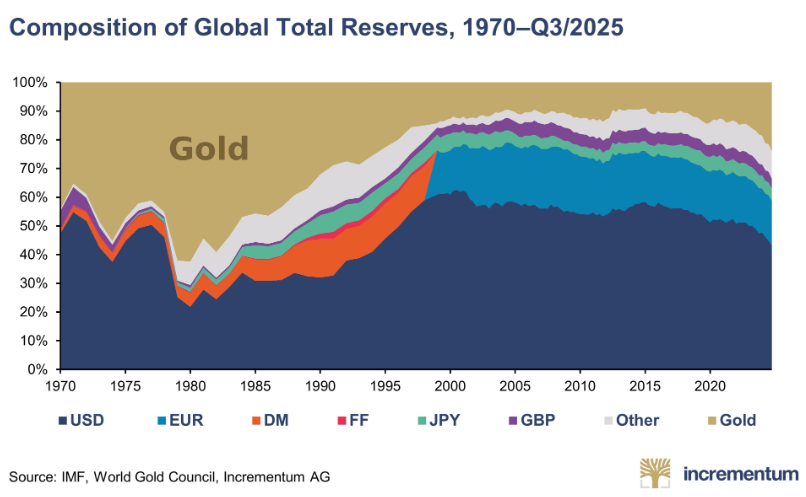
The historical chart of 55 years exposes three distinct monetary regimes:
| Period | USD Slice | Gold Slice | System Structural Dynamics |
| 1970 – 1980 | ~20% to 50% | > 60% (Pico) | End of Bretton Woods, galloping inflation and global run for tangible collateral. |
| 1990 – 2010 | ~60% to 62% (Pico) | ~10% to 15% | Unipolar hegemony of the Dollar, accelerated globalization and fiduciary complacency ("end of history"). |
| 2015 – 2026 | 43% (Free fall) | 24% (On the Rise) | Accelerated dedollarization: sanctions, US fiscal dominance and massive return to Outside Money. |
The 24% Benchmark: Where's Private Money?
The report In Gold We Trust (IGWT) brings a mathematical provocation that dismantles the default retail investor portfolio: if institutions issuing the fiduciary currency allocate 24% of their assets in gold, why would a private portfolio keep less than 2%?
[ BANCOS CENTRAIS GLOBAIS ] ────────► 24% Alocado em Ouro Físico (Proteção Soberana)
                                                ▲
                                                │   O GAP DE LIQUIDEZ
                                                │   (Demanda Reprimida de Trilhões)
                                                ▼
[ INSTITUIÇÕES E FUNDOS PRIVADOS ] ─► < 2% Alocado em Ouro (Vulnerabilidade Fiduciária)
"Central Banks do not buy gold to beat quarterly dividend targets; they buy to ensure the state's survival if the credit system collapses. When the custodian of the currency exchanges 24% of his reserves for physical gold while the private institutional market holds only 1% to 2%, the message is crystal clear: paper emitters are rejecting their own paper." — Igor Pereira
The Asymmetries of Repeal
The practical consequence of this allocation divergence dictates the trend of the coming years:
Gap Close: For which pension funds, family offices and private managers rise their positions from the current 1%–2% to a fraction of the level of central banks (e.g. 5% to 10%), the required capital flow exceeds the total annual mineral production of mining companies.
The Lack of Physical Floating (Free Float As Asian Central Banks and investors do not sell their bars — they take them out of circulation in definitive custody vaults — investors who arrive late will have to compete for an increasingly low market share, forcing the adjustment for the screen price.
ExpertFX Strategic Guidelines
You It's at the front of the cycle: If you already maintain a structural allocation between 10% and 25% of your portfolio in real assets (Gold, Silver, $BTC and high-bank producers like$PAAS and GDX), you are aligned with central bank strategy, not retail compliance.
Do not treat Gold as Short Term Trade: Gold at 24% of global reserves is not a tactical operation of graphical oscillation; it is the return of sovereign ballast.
Enjoy Institutional Myopia: While the broad market pursues overvalued papers in currencies that lose 5% to 10% real purchasing power per year, the Smart Money continues using the technical retreats to consolidate reserves at the summit of the Exter Pyramid.
The trust system has already chosen its security anchor. Whoever understood the figures before the institutional market has already secured its place on the right side of financial history.
Comments
Post a Comment